At an industrial trade show, conversations are long and technical. A visitor arrives with a drawing, a production rate, a deadline constraint or a tender in preparation. Their business card says nothing about any of this. If the salesperson does not write it down during the conversation, it remains just a name in a pile.
This page is for manufacturers, distributors and integrators who exhibit at machinery, subcontracting, automation or maintenance shows.
What sets an industrial lead apart
- The cycle is long: from the first conversation to the order, months can go by. The lead must remain usable long after the show.
- Several people decide: the buyer, the technical manager, the production director. The contact you met is not always the one who signs.
- The need is precise: a capacity, a material, a standard, a deadline. This detail is what makes a relevant offer possible.
- Resellers and integrators matter: a visitor may be an end customer or a partner who will resell your product.
What to note on the stand
During or just after the conversation:
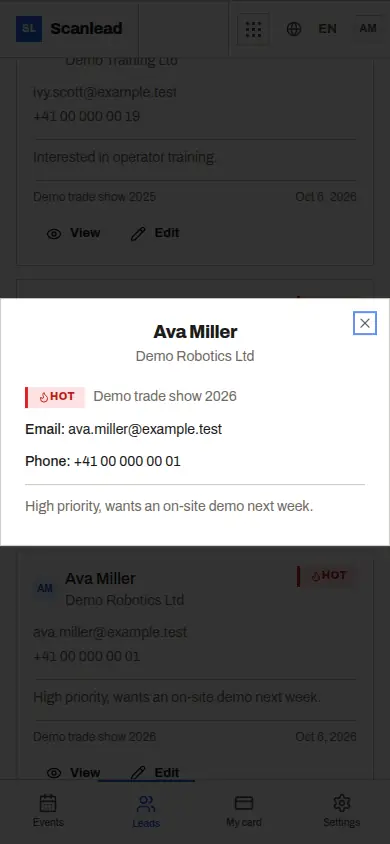
- The temperature: hot (project and deadline), warm (genuine interest, no project yet), cold (curiosity, market watch).
- The need in one line: "replacing 2 presses, 2027 budget", "looking for an ISO 13485-certified subcontractor".
- The visitor's role: buyer, technical, management, reseller.
- The promised next step: offer, factory visit, sample, demonstration, with a date.
How Scanlead handles it
- Business card photographed: name, company, job title, email and phone number are read; the job title is a separate field, useful for telling a buyer from a technician.
- Badge QR code read directly if it contains the visitor's contact details.
- Hot, warm, cold and notes on the spot, editable afterwards: the note can be found by searching.
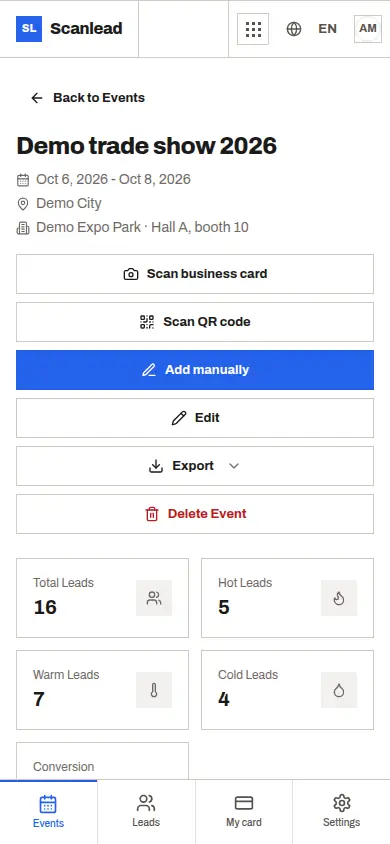
- One show = one list with its own statistics and export. Shows can be compared with one another: useful for deciding which shows to repeat next year.
- Offline: industrial halls often have poor coverage. Open Scanlead while you still have a network; if the connection drops afterwards, badge QR codes and manual entry keep working and contacts sync once it is back. Reading a business card needs a connection.
- Team of up to five with Pro+: the technician and the salesperson enter contacts in the same list, each signed with their name.
What Scanlead does not do
- It does not read badges that only contain a number from the organiser's database. At those shows, photograph the business card.
- It has no customisable questionnaire (mandatory fields, multiple-choice questions): qualification relies on the temperature and the note. If your process requires a detailed questionnaire for each visitor, tools such as speedlead or LEADHOUND offer one; for how such tools are priced, see Lead capture for small exhibitors.
Preparing the show before you go
- Create the trade show in Scanlead before you leave and test a business card capture: the first morning is not the time to discover the app.
- Write the temperature rule in one sentence and share it with the team, for example "hot = a project that can be quoted, with a known deadline".
- Agree on abbreviations for notes: RFQ (request for quotation), SMP (sample), VIS (plant visit). They keep each note short.
- Prepare the follow-up documents in advance: data sheets, references, terms. The promised quote then goes out within the week instead of waiting on the engineering team.
After the show
Over a long cycle, the first follow-up matters less than regularity. Sort by temperature, send the promised offer to hot contacts within the week, and keep warm contacts in your CRM with a dated next action. To move the contacts into your CRM and follow them up: Trade show leads to your CRM.